
Tequila Alcohol Content: Proof, ABV & Percentage Guide
Most tequila is bottled at 40% ABV — 80 proof. Mexican law (NOM-006-SCFI-2012) allows anywhere from 35% to…
Most tequila is bottled at 40% ABV — 80 proof. Mexican law (NOM-006-SCFI-2012) allows anywhere from 35% to 55% ABV, and both ends of that range are real bottles you can buy. Anything sold as tequila in the United States must be at least 40%, which is why the US shelf looks so uniform and why a bottle bought in México often is not.
Some links on this page are affiliate links. If you buy through one, this site earns a commission at no extra cost to you. It does not change which bottles are recommended or what is said about them. Full disclosure.
Aging does not change any of this. A reposado is not stronger than a blanco, and an añejo is not stronger than either — proof is set at bottling, not in the barrel. What follows is the full range by type and by brand, why your own bottle may not match the number every other guide prints, and how to read the figure off the label yourself.
Tequila ABV by Type
| Type | Typical ABV | Typical proof | Legal range |
|---|---|---|---|
| Blanco / Silver | 40% | 80 | 35–55% |
| Reposado | 40% | 80 | 35–55% |
| Añejo | 40% | 80 | 35–55% |
| Extra Añejo | 40% | 80 | 35–55% |
| Cristalino | 35–40% | 70–80 | 35–55% |
| Still strength / overproof | 46–55% | 92–110 | 35–55% |
Aging does not change alcohol content. This is the single most common misunderstanding about tequila strength, and it is worth stating plainly: an añejo is not stronger than a blanco. Barrel time changes colour and flavour. Proof is decided at bottling, when the distiller cuts the spirit with water to the number on the label. A producer whose blanco, reposado and añejo all read 40% has done exactly that, three times.
Mexico’s NOM-006-SCFI-2012 permits 35–55% Alc. Vol. Spirits sold as tequila in the United States must be bottled at 40% or higher, which is why the 40% figure is near-universal on an American shelf — and why the range below the line only becomes visible once you look at bottles sold in México.
Why Your Bottle Says 35% or 38% When Every Guide Says 40%
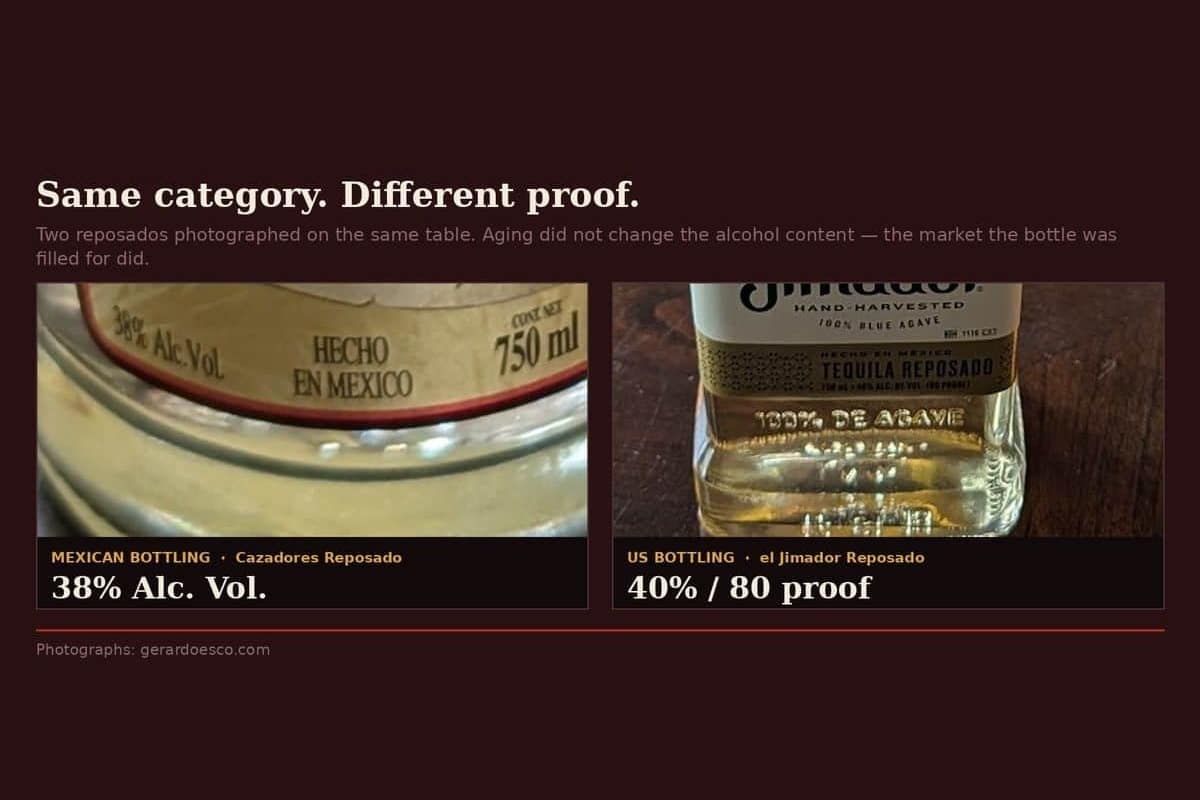
40% is the US standard, not the law. If the label in your hand reads something lower, nothing is wrong with it and it has not been watered down — you are holding a different bottling of the same tequila. Below are three real tiers, every figure read off a bottle photographed on my own table rather than copied from a brand’s press kit.
| Tier | Proof | Where you’ll see it |
|---|---|---|
| 40% ABV | 80 proof | The US standard. Nearly every bottle on an American retail shelf. |
| 38% ABV | 76 proof | The common Mexican-market bottling. Same brand, same expression, two points lower. |
| 35% ABV | 70 proof | The legal floor. Concentrated in decanters, painted ceramic and cristalinos sold as “premium.” |
The 35% tier: the most expensive-looking bottles are the weakest
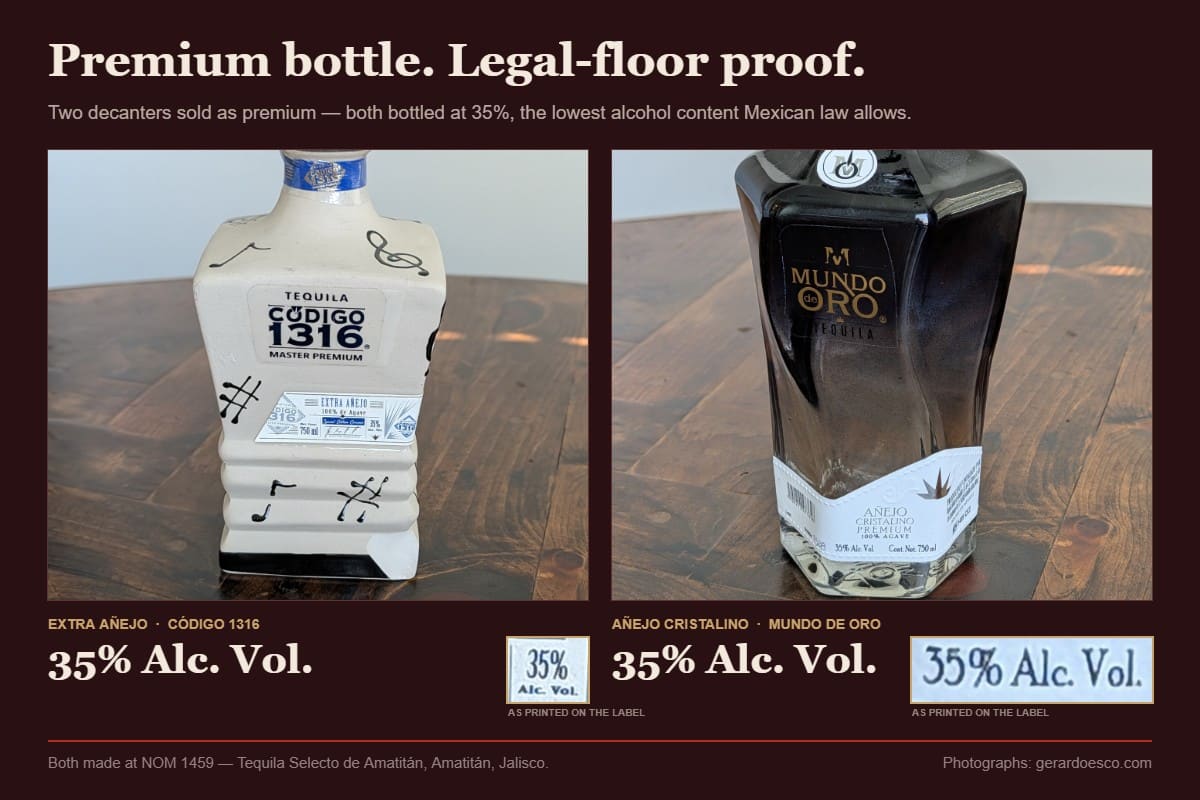
This is the part that runs opposite to what the packaging implies. Every bottle below is at 35% ABV — the legal minimum for tequila — and every one is sold as premium, master premium or platinium, in a decanter, a hand-painted ceramic or a heavy etched flask.
| Bottle | Type | ABV | NOM | How it’s sold |
|---|---|---|---|---|
| Código 1316 | Extra Añejo | 35% / 70 proof | 1459 | “Master Premium,” hand-painted ceramic decanter |
| Mundo de Oro | Añejo Cristalino | 35% / 70 proof | 1459 | “Premium,” smoked-glass decanter |
| Don Ramón Platinium | Añejo Cristalino | 35% / 70 proof | 1417 | “Platinium,” etched flask, 700 ml |
| La Cuerda | Añejo | 35% / 70 proof | 1589 | Hand-painted decanter, coat-of-arms motif |
Three of the four are cristalinos or extra añejos — the categories that carry the highest price tags. The pattern is consistent enough to state plainly: in the Mexican domestic market, an elaborate bottle is not a signal of higher proof, and is sometimes a signal of the opposite. The by-brand table further down already shows Don Julio 70 at 35%. What these four add is that 35% is not a quirk of one cristalino — it is a whole tier.
None of this makes them bad tequila, and none of it is hidden: the ABV is printed on every one of these labels exactly where the regulation requires. But if you are comparing two bottles on price, you are entitled to know that one holds 12.5% less alcohol per pour than the 40% bottle beside it.
The same bottle is not the same proof
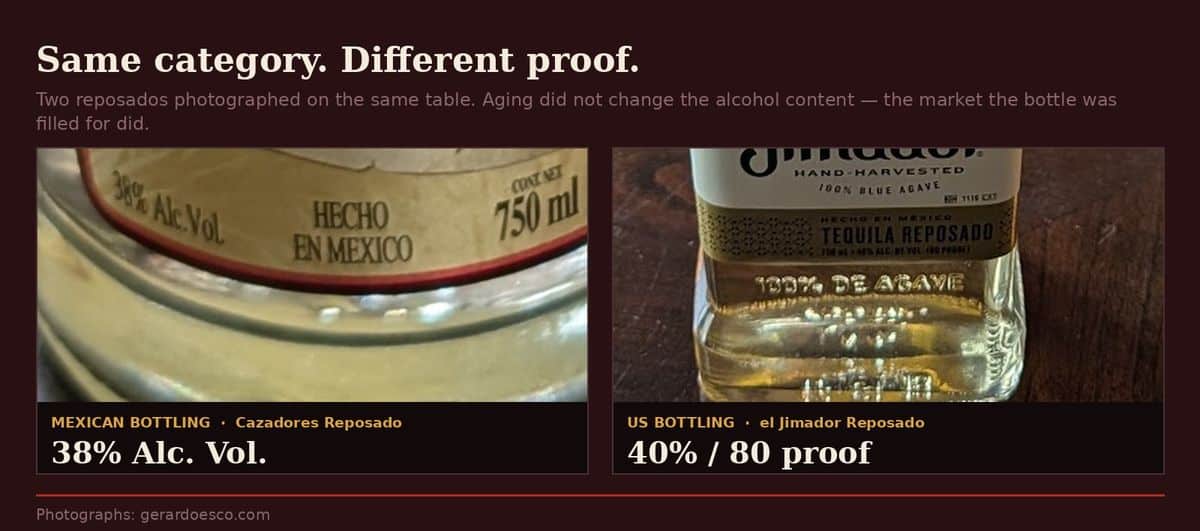
The clearest way to see the tiers is one brand across two markets. The US figure published everywhere — including in the by-brand table on this page — is 40%. The Mexican-market bottles of the same expressions read 38%.
| Expression | US bottling | Mexican bottling |
|---|---|---|
| Don Julio Blanco | 40% / 80 proof | 38% / 76 proof |
| Don Julio Reposado | 40% / 80 proof | 38% / 76 proof |
| Maracame Añejo (NOM 1456) | — | 38% / 76 proof |
Neither number is wrong. They are two true facts about two different bottlings, and the only way to know which one you own is to read the bottle. That is why every figure on this page is labelled with the market it describes.
The volume trap: 700 ml is not 750 ml
Mexican-market bottles are frequently 700 ml or 70 cl, not the 750 ml an American buyer assumes. Combine that with a lower ABV and the gap is larger than either figure suggests on its own:
- 750 ml at 40% → 300 ml of pure alcohol
- 700 ml at 38% → 266 ml — about 11% less
- 700 ml at 35% → 245 ml — about 18% less
Two bottles at the same shelf price can differ by nearly a fifth in what is actually in them. Check the volume and the ABV together, not one or the other.
Tequila ABV by Brand
Both legal endpoints are real bottles you can buy. Everything between them is a choice the producer made at bottling.
| Brand & expression | ABV | Proof |
|---|---|---|
| Don Julio 70 (cristalino) | 35% — the legal floor | 70 |
| Patrón Silver · Don Julio Blanco / Reposado / Añejo / 1942 · Jose Cuervo Especial Gold · Espolòn Blanco · 1800 Silver | 40% | 80 |
| Fortaleza Still Strength Blanco | 46% | 92 |
| Cascahuín Plata 48 | 48% | 96 |
| Don Fulano Fuerte · Cazcanes No. 10 | 50% | 100 |
| Tequila Ocho Plata Puntas · G4 108 | 54% | 108 |
| Tapatío 110 Blanco | 55% — the legal ceiling | 110 |
Figures are for US bottlings unless noted. Still-strength releases vary batch to batch by design — that is the point of them — so treat those rows as the range rather than a fixed number.
How to Check the Bottle in Your Hand
- Find the ABV, not the proof. Mexican labels print
% Alc. Vol.and often print no proof at all. To convert, double it: 38% ABV is 76 proof. - Check the volume in the same glance. 700 ml and 750 ml sit side by side on the same shelf at the same price.
- Read the NOM while you are there. The four digits next to
CRTidentify the distillery that actually made it, which tells you more than the brand name does — here is what the NOM number means. - Anything below 35% is not tequila. If a bottle reads 30% or 25%, it is a tequila-based liqueur or a flavoured spirit, whatever the front of the label suggests.
If you want the rest of what is printed on a back label decoded — the NOM, the CRT mark, 100% de agave versus mixto, the bottler statement — the full walkthrough is in our guide to reading a tequila label.
What Actually Sets the Proof
Tequila comes off the second distillation at roughly 55–70% ABV. Almost everything that happens after that is subtraction, and only two decisions really matter.
The cut with water. This is the one that sets the number on the label. The distiller adds purified water to bring the spirit down to the target ABV, and the target is a commercial decision — the legal floor, the US import requirement, what the category expects, what the price point supports. A producer bottling at 35% for the domestic market and 40% for export is making that decision twice for the same liquid.
The choice not to cut at all. A still-strength or puntas release skips the dilution and bottles at or near distillation strength. That is where the 46–55% bottles in the table above come from, and it is a deliberate style, not a stronger tequila by accident.
Two things that are commonly credited and should not be: agave maturity affects sugar available for fermentation, and therefore yield and flavour, not the bottled ABV; and barrel aging loses volume to evaporation but does not raise the proof of what reaches the bottle, because the cut happens afterwards. If you want the barrel side of that story, see the tequila aging process.
High-Proof Tequila: 100 to 110 Proof
The ceiling is 55% ABV, 110 proof, and nothing may legally be bottled stronger and still be called tequila. Tapatío 110 Blanco sits exactly at that line.
High-proof tequila is not simply the same drink turned up. Less water means less of the dilution that rounds a spirit off, so more of the distillate’s own character survives to the glass — cooked agave, black pepper, minerality, and whatever the still actually produced. It is also less forgiving: a flaw that 40% would have smoothed over is fully audible at 55%.
Practically: add a few drops of water rather than ice if you want to open one up, since ice chills as it dilutes and cold mutes aroma. In a cocktail, a 50% blanco lets you use less tequila for the same backbone, which is why bartenders reach for them. And treat the pour size as real — a 1.5 oz measure at 55% carries nearly 40% more alcohol than the same measure at 40%.
Does Higher Proof Taste Better?
No — but it tastes like more, which is easy to mistake for better.
Alcohol carries aroma. Raise the ABV and more volatile compounds reach your nose, so a high-proof pour reads as bigger, warmer and more intense. It also numbs: past roughly 50% the burn starts competing with the flavour it is delivering, and palate fatigue arrives faster. The sweet spot is personal, and it is not a ranking.
What proof to buy depends entirely on what you are doing with it:
- Sipping neat — 40–46% is the comfortable band for most people. Use a copita or a Glencairn, not a shot glass, and skip the lime and salt; both exist to hide a spirit, not to show one.
- Margaritas and mixed drinks — 40% blanco. Citrus and sweetener flatten subtlety, so an expensive or high-proof bottle is wasted here.
- Spirit-forward cocktails — 46–50%. Stirred drinks pick up water from the ice, and a higher-proof base survives that dilution with its character intact.
- Cooking — 40%, and the cheapest bottle you would still drink.
- A tasting flight — go low to high. A 55% pour first will flatten everything that follows it.
Flavour at any proof comes mostly from elsewhere — the agave, the distillery, the barrel. The tequila flavour wheel is the better tool for working out what you are actually tasting.
Tequila Alcohol Content: FAQ
Is 35% tequila real tequila?
Yes. NOM-006-SCFI-2012 sets the range at 35–55% ABV, so 35% is fully compliant tequila at the legal minimum. It is weaker than the 40% you are used to, but it is not diluted, fake or mislabelled. It simply cannot be sold as tequila in the United States, which is why you are more likely to meet one in México.
Why is my tequila 38% instead of 40%?
You almost certainly have a Mexican-market bottling. 38% is common for bottles sold inside México, while the same brand and expression is typically bottled at 40% for the United States.
Does a 35% tequila cost less?
Usually not, and that is the point of the table above. Several of the 35% bottles on my shelf are cristalinos and extra añejos in elaborate decanters, sold at premium prices.
Is reposado stronger than blanco?
No. Aging changes colour and flavour, not alcohol content. Proof is set at bottling, after the barrel. A producer’s blanco, reposado and añejo are normally all bottled at the same ABV.
Is tequila stronger than vodka or whiskey?
No — at the standard bottling they are the same. Vodka, whiskey, rum, gin and tequila all cluster at 40% ABV / 80 proof. A 1.5 oz shot of tequila and a 1.5 oz shot of vodka contain the same amount of alcohol. Tequila’s reputation for hitting harder is about how it is drunk, not what is in it.
What is the strongest tequila you can legally buy?
55% ABV / 110 proof. Tapatío 110 Blanco sits exactly at that ceiling. Anything stronger cannot legally be called tequila.
How much alcohol is in a shot of tequila?
A 1.5 oz (44 ml) shot at 40% contains about 17.6 ml of pure alcohol — one US standard drink. The same shot at 55% contains about 24 ml, closer to one and a half.
How many shots are in a bottle of tequila?
About 17 at 1.5 oz from a 750 ml bottle, or 16 from a 700 ml one. If the 700 ml bottle is also 35% rather than 40%, it holds roughly 18% less alcohol overall.
Does the proof change once the bottle is open?
Not meaningfully, and not quickly. Unlike wine, tequila does not continue to develop in the bottle. A part-full bottle stored upright and out of sunlight will lose a little to evaporation over years, not months — see how to store tequila properly.
The Bottom Line
40% is the number to expect and the number you will nearly always meet on a US shelf. The useful knowledge is what sits either side of it: a legal range of 35–55%, a Mexican market that routinely bottles at 38% and sometimes at the 35% floor, and a still-strength tier that deliberately skips the dilution altogether.
Aging is not part of any of it. If you remember one thing from this page, make it that: an añejo is not stronger than a blanco, and a bottle in an impressive decanter is not stronger than a plain one — several of the ones on my shelf are weaker.
The figure is printed on every bottle. Once you know to look for % Alc. Vol. and the volume beside it, you never have to take a guide’s word for it again, including this one.
Learn More About Tequila
- How to Read a Tequila Label — the NOM, the CRT mark, 100% de agave versus mixto
- What Does NOM Mean on Tequila? — the four digits that name the distillery
- Silver vs. Gold Tequila: What’s the Difference?
- The Five Tequila Regions of Mexico
- The Tequila Flavour Wheel
- The Types of Tequila, Explained
- Añejo Tequila: Aging, Flavour and Picks
- How to Store Tequila Properly
- Graduación del tequila: ¿cuántos grados tiene? (en español)