
If you went looking for a list of additive-free tequilas, you found one. Several sites still publish “2026 verified additive-free” lists. Here is the problem with all of them: the programme that produced those verifications stopped publishing in October 2024, and nothing has replaced it.
This page covers what the rules actually permit, what happened to verification, why the lists you are being shown are reprints of a dead register — and the four things you can still check yourself at the shelf.
Some links on this page are affiliate links. If you buy through one, this site earns a commission at no extra cost to you. It does not change what is said about any bottle. Full disclosure.
What the Rules Actually Permit
Mexico’s tequila standard, NOM-006-SCFI, allows up to 1% of finished volume in four additives:
| Additive | What it does |
|---|---|
| Caramel colouring | Adds colour — makes an unaged or lightly aged spirit look older |
| Oak extract | Adds wood colour and flavour without the barrel time or the evaporation loss |
| Glycerin | Changes mouthfeel — makes the spirit feel rounder, thicker, less hot |
| Sugar-based syrup | Adds sweetness and softens the finish |
None of the four has to appear on the label. A bottle can be 100% agave, entirely legal, correctly labelled, and still contain all of them.
One percent sounds like nothing. It is not, and the reason is straightforward: those four were not chosen at random. They are the compounds that do the most at the lowest concentration. Glycerin measurably changes texture well below 1%. Syrup changes perceived sweetness. Nobody adds 1% of anything to a spirit for no reason — they add it because at that dose it works.
This matters most in aged categories, where oak and additives produce overlapping effects and a drinker genuinely cannot separate them in the glass. It matters in blanco too, where there is no oak to hide behind and glycerin is doing all the work.
Why There Is No Verified List Any More
For several years the Additive Free Alliance sent inspectors to distilleries and published the results through the Tequila Matchmaker app. It was not an official certification, but it was the only thing resembling independent verification that consumers had. Here is what happened to it.
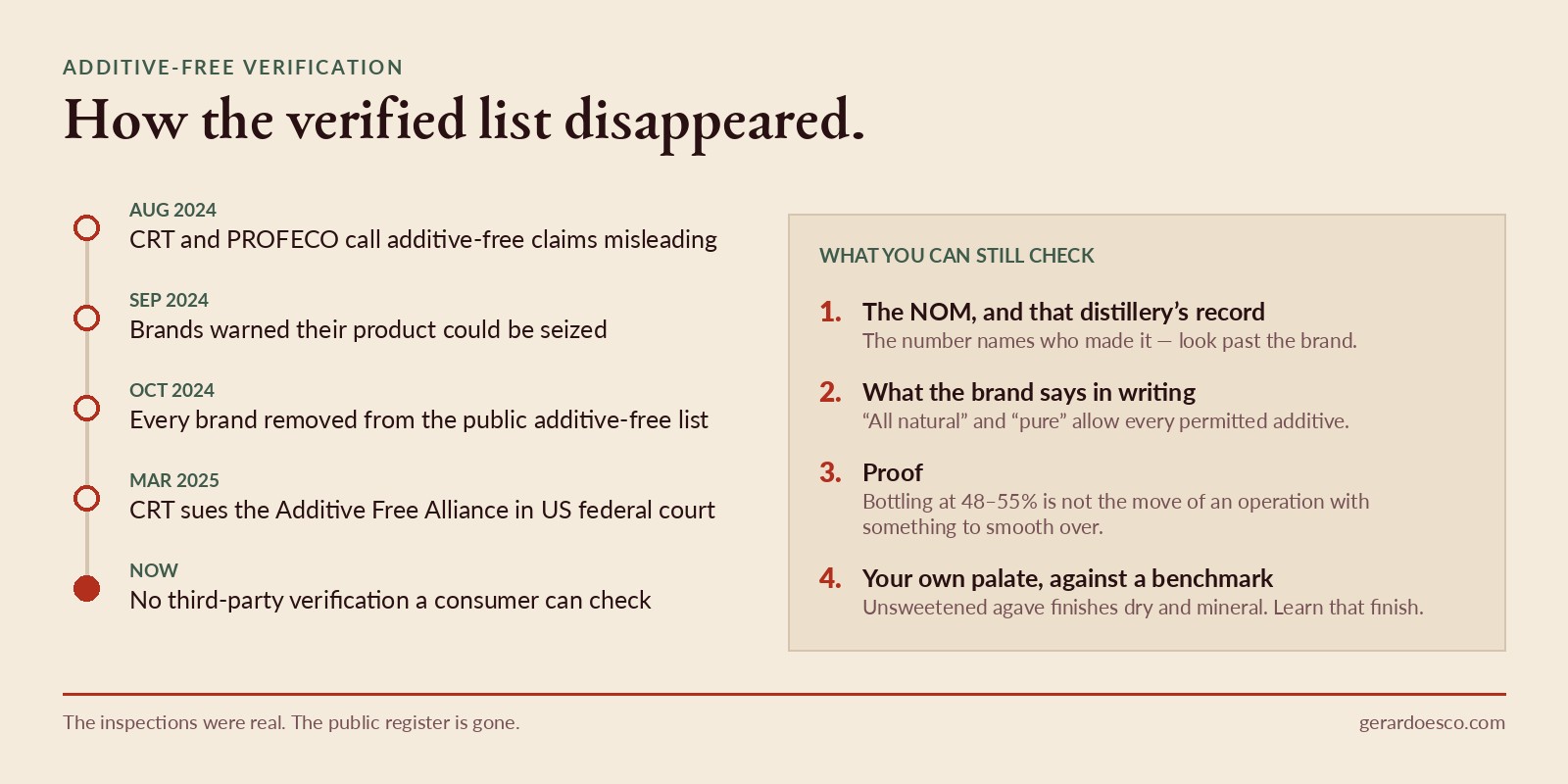
| When | What happened |
|---|---|
| August 2024 | The Consejo Regulador del Tequila (CRT) and consumer agency PROFECO issue a joint statement saying “additive free” claims cause consumer confusion. |
| September 2024 | The CRT sends letters to tequila brands warning that additive-free language could lead to penalties including seizure of product. |
| October 2024 | The Additive Free Alliance removes every brand from its public list. Co-founder Grover Sanschagrin described an emergency board meeting and taking all the brands off “just to protect them from their own regulator.” |
| March 2025 | The CRT sues the Additive Free Alliance and S2F Online in US federal court, asserting that it is “the sole certifier of Tequila.” |
| May 2025 | The AFA rejects the exclusivity claim, pointing to Certificación Mexicana — a competing accreditation body established in 2022 — and arguing its evaluations are independent, voluntary and protected speech. |
| Now | The AFA members page is empty. The organisation states its work “does not constitute a form of certification or confirmation regarding the presence or absence of additives in tequila.” |
Read that carefully, because the distinction matters: the inspections were real and the findings were real. What no longer exists is the public register where a buyer could look a bottle up. The information did not turn out to be wrong. It was withdrawn under legal pressure.
So why is everyone still publishing lists?
Partly inertia, partly because those pages rank. The old data circulated widely before it came down and it is easy to reprint.
The trouble is what happens to data nobody is checking. Comparing several currently-ranking additive-free lists against distillery records turns up straightforward errors — one attributes Tapatío to NOM 1579 and Patrón to NOM 1146. Tapatío is NOM 1139 (Destilería La Alteña, Arandas). Patrón is NOM 1492. NOM 1146 is La Tequileña, which makes Don Fulano and Tears of Llorona. A list that misidentifies which distillery made a bottle is not verifying anything about it.
The Four Things You Can Still Check
No certification means no shortcut. It does not mean no information. These four, in order of how much they tell you:
1. The NOM, and what that distillery is known for
Every bottle carries a four-digit NOM number identifying the distillery that made it. The number itself is not a quality signal — one NOM can produce a mixto and a superb 100% agave bottle side by side. What it gives you is the ability to look past the brand on the front to the operation behind it, and some operations have spent decades building a reputation that additives would destroy.
2. What the brand says in writing
A brand that publishes an explicit, unhedged additive-free statement on its own site has put something at risk to do it. That is weaker than an inspection but stronger than silence. Be alert to the hedges: “no artificial flavours,” “all natural,” and “pure” are compatible with every additive on the permitted list.
3. Proof
Additives are corrective. A distillery bottling at 48–55% is choosing to show you more of the spirit, not less, and that is not the behaviour of an operation with something to smooth over. It is circumstantial, not proof — but the correlation is real, and you can read it off the label.
4. Your own palate, against a benchmark
Buy one bottle from a distillery with a long clean record and learn what it tastes like. Unsweetened agave has a dry, mineral, slightly austere finish. Once you know that finish, a syrupy one is obvious. This is the slowest method and the only one nobody can take away from you.
Distilleries With the Longest Clean Records
These are not certifications — no such thing currently exists. They are distilleries with long-standing reputations for traditional production and no additive use, every NOM here checked against distillery records rather than copied from another list.
| NOM | Distillery | Brands you will see |
|---|---|---|
| 1493 | Tequila Los Abuelos | Fortaleza |
| 1139 | Destilería La Alteña, Arandas | Tapatío · El Tesoro · Villa Lobos |
| 1120 | Tequila Siete Leguas, Atotonilco el Alto | Siete Leguas |
| 1579 | Destilería El Pandillo | G4 · Pasote · Terralta · ArteNOM Selección de 1579 |
| 1146 | La Tequileña | Don Fulano · Tears of Llorona |
| 1123 | Tequila Cascahuín | Cascahuín |
| 1474 | Cía. Tequilera Los Alambiques, Arandas | Tequila Ocho (since 2021) |
| 1599 | — | Cazcanes |
Almost none of these are stocked by large chain retailers, which is why you will not find a wall of buy buttons below this table. The one widely available exception is Fortaleza Añejo — stone tahona milling, open-air fermentation, copper pot stills, and the usual reference point when people argue about what tequila is supposed to taste like. Everything else on that list is a specialist-shop purchase.
One warning: the NOM can change between releases
A brand is not permanently attached to a distillery. Tequila Ocho is the clearest example: originally produced at NOM 1139 (La Alteña), it has been made at NOM 1474 since 2021, and production has moved between the two depending on capacity — some releases have gone back to La Alteña.
Neither distillery is a problem. The lesson is narrower and more useful: a reputation attaches to a distillery, but you are buying a bottle. Read the NOM on the one in your hand, not the one a list recorded two years ago.
What This Site Does With the Word “Verified”
Other pages here carry an “additive-free verified” column. It means one thing, and only one: that distillery was physically inspected before October 2024, when the results were still public. It is a historical record of an inspection, not a current certification, and nobody — including this site — can offer you the latter right now.
Where a column says not verified, that is not an accusation. It means no inspection was ever published for that distillery. Plenty of good producers were never inspected before the programme stopped.
Additive-Free Tequila: FAQ
Is there an official additive-free certification in 2026?
No. The Additive Free Alliance list came down in October 2024 and the CRT sued the organisation in March 2025. The AFA now states explicitly that its work does not constitute certification. Any list presented as currently verified is reprinting pre-2024 data.
Do additives have to be listed on the label?
No. Up to 1% of finished volume in caramel colouring, oak extract, glycerin and sugar-based syrup is permitted with no disclosure requirement.
Does “100% agave” mean additive-free?
No, and this is the most common confusion. “100% agave” means all the fermentable sugars came from agave rather than cane or corn — it is a statement about the base, not about what was added afterwards. A 100% agave tequila can contain all four permitted additives.
Can you taste 1% of additives?
Often, yes — not as a flavour you can name, but as texture and sweetness that do not match the rest of the profile. The reliable way to learn it is to drink a bottle from a distillery with a long clean record and pay attention to how the finish ends.
Is additive-free tequila better?
It is more honest, which is not the same claim. A tequila with additives can be pleasant. The objection is that you cannot tell, because nothing on the label says so — and that a producer correcting a spirit into shape is selling you something other than what the category implies.
What is the CRT?
The Consejo Regulador del Tequila, the body that certifies tequila production against NOM-006-SCFI. It assigns the NOM numbers and holds that it is the sole certifier of tequila — the position at the centre of the additive-free dispute.
Where to Go Next
- What the NOM number means — how to find out which distillery made your bottle
- Blanco tequila — the category where additives have nowhere to hide
- Añejo tequila — where oak and additives produce the same effects
- Tequila proof and alcohol content — why high-proof bottling is a signal
- How to read a tequila label
- Silver vs gold tequila — caramel colouring in its most visible form