
What Does NOM Mean on Tequila?
NOM stands for Norma Oficial Mexicana — Mexico’s system of official standards. On a tequila bottle, the NOM…
NOM stands for Norma Oficial Mexicana — Mexico’s system of official standards. On a tequila bottle, the NOM is a four-digit number identifying the distillery where that tequila was physically produced. It tells you who made it, not who sells it.
You’ll find it on the back label, printed in small type near the volume and alcohol content. It’s easy to miss, and it’s the most useful thing on the bottle.
Where to find the NOM on your bottle
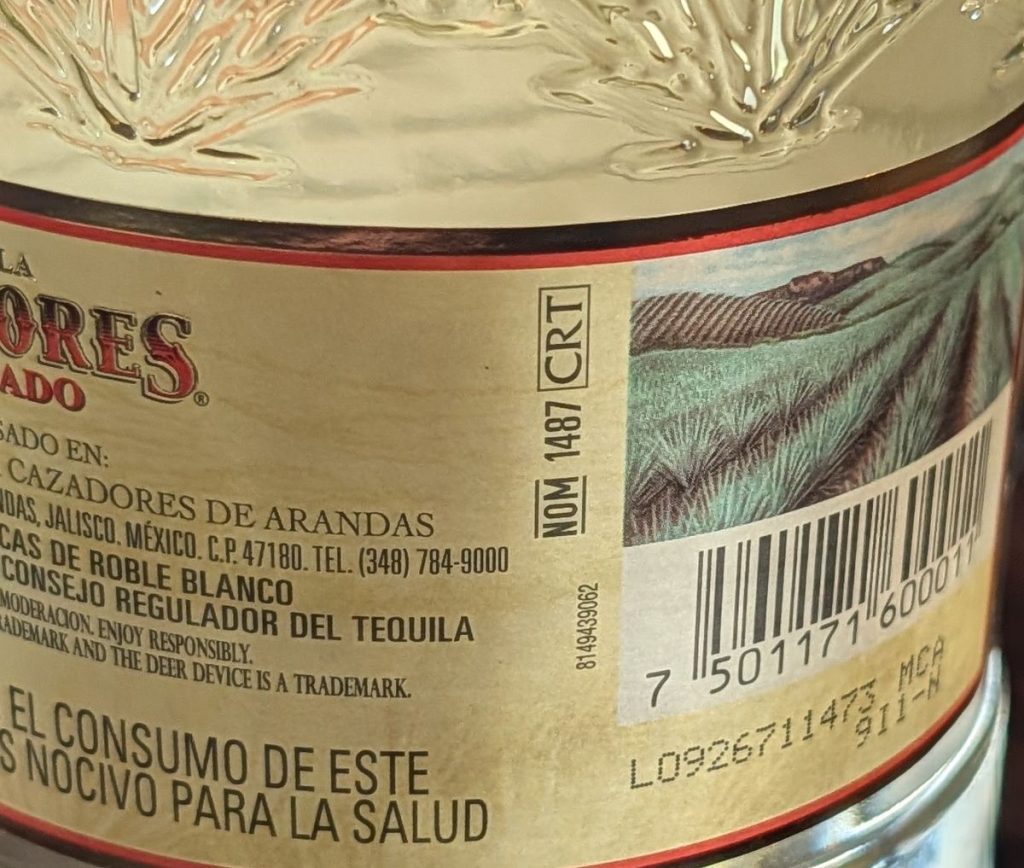
Turn the bottle around. Look at the dense block of small text near the ABV and the volume — usually alongside the importer details and the government warning.
You’re looking for three letters and four digits:
NOM 1119 CRT
That is a real one, off my own el Jimador — NOM 1119 is Casa Herradura in Amatitán. Every tequila legally produced and exported carries one. If a bottle claiming to be tequila has no NOM, it either isn’t tequila or it isn’t legitimate.
What the number actually identifies
The NOM identifies a physical production facility — a distillery, called a fábrica — registered with the Consejo Regulador del Tequila, the CRT.
The CRT is the regulatory body that certifies producers, audits production and enforces the denomination of origin under Mexican law. It assigns each authorized distillery a NOM and maintains the registry.
This is the crucial distinction: the NOM belongs to the distillery, not the brand. A brand may own its distillery outright, or it may pay to have its tequila made at someone else’s.
The maths that surprises people
There are roughly 1,400 registered tequila brands on the market. There are only about 140 licensed distilleries in Mexico producing them.
Ten brands per distillery, on average. And the average hides the extremes — according to VinePair’s analysis, only around 2% of tequila brands are made at a dedicated facility. Fewer than thirty brands in the entire category have a NOM to themselves.
Contract production is not a scandal. It’s simply how the industry works, and some of the best tequila on the shelf is made under contract at someone else’s distillery. But it does mean the story on the front of the bottle — the family heritage, the generations of expertise — is sometimes a story about a building the brand doesn’t own.
The NOM is how you check.
What one NOM looks like across many brands
A few real examples, from smallest to largest:
| NOM | Distillery | Brands produced |
|---|---|---|
| 1493 | Fortaleza | One. A dedicated single-brand facility. |
| 1492 | Patrón | One. Also dedicated. |
| 1440 | — | Espolón and Cabo Wabo, among others |
| 1119 | Casa Herradura | Herradura and El Jimador |
| 1122 | José Cuervo | Cuervo plus around seventeen more brands |
| 1438 | Destiladora del Valle de Tequila | Over two hundred active labels |
That last row is worth sitting with. A single facility producing more than two hundred brands is not unusual at the high-volume end of the category — and the labels on those bottles range from supermarket own-brand to celebrity-fronted premium.
Two bottles that look nothing alike, at very different prices, can come out of the same building.
A worked example: two place names on one bottle
Here is one from my own shelf, and it works as an example precisely because nothing shady is going on.
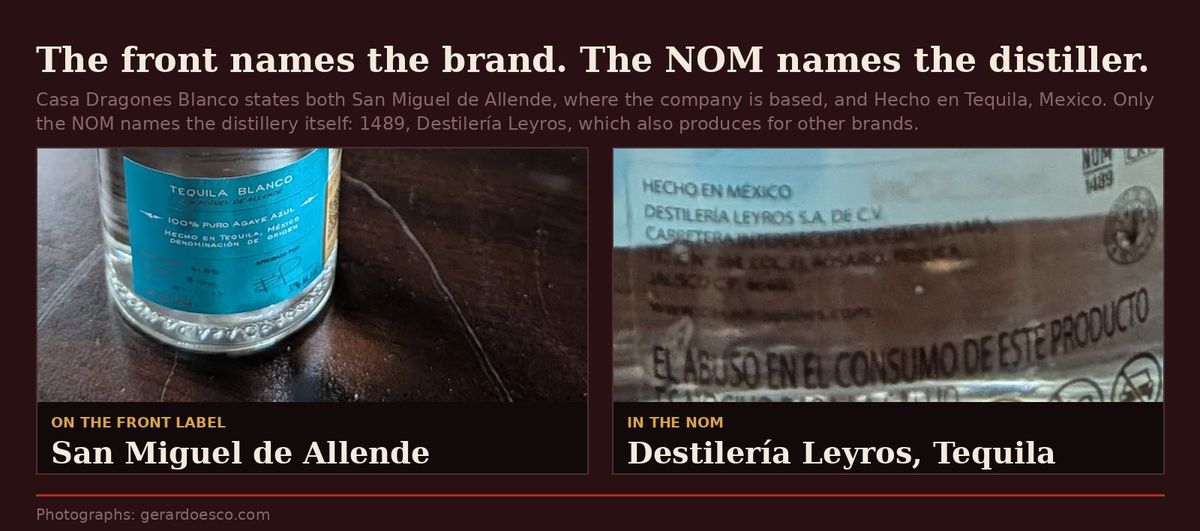
The front of a Casa Dragones Blanco reads Tequila Blanco · San Miguel de Allende, and just below that, Hecho en Tequila, México. Both are true. San Miguel de Allende is in Guanajuato, roughly 300 miles away — it is where the company is based, not where the tequila is made, and the label says so plainly.
Turn the bottle around and the NOM gives you the part neither place name does: 1489 — Destilería Leyros S.A. de C.V., in the town of Tequila.
That is a different kind of fact. “Hecho en Tequila” names a town. The NOM names a building — and that building currently turns out around 38 brands, Casa Dragones among them. Bottles that look nothing alike, at very different prices, with entirely different stories on the front, come off the same equipment.
None of this makes a tequila good or bad. Contract distilling is normal, some excellent bottles are made that way, and every one of these brands prints its NOM because the regulation requires it. The point is narrower and more useful than a gotcha: the front of the bottle is doing brand work, and the NOM is doing identification work. If you want to know who actually made what you are drinking, those four digits are the only place that answers it.
What a NOM does not tell you
This matters as much as what it does tell you, and it’s where most explainers oversell.
A shared NOM does not mean identical liquid. Two brands produced at the same distillery can differ substantially — different agave sources, different cooking and fermentation specifications, different aging, different cut points. The distillery executes to each brand’s spec.
A NOM is not a quality rating. There is no good NOM or bad NOM. A lower number doesn’t mean older or better. It’s a registration code, not a ranking.
A NOM doesn’t tell you about additives. Mexican regulation permits small quantities of additives — sweeteners, coloring, glycerin, oak extract — without disclosure on the label. The NOM says nothing about whether a bottle contains them.
A NOM doesn’t tell you the agave source. A distillery can buy agave on the open market or grow its own, and both can happen under the same NOM in the same year.
How to look up a NOM
- Read the number off the back label. Four digits, after the letters NOM.
- Check it against the CRT registry to confirm which distillery it belongs to. The CRT is the authoritative source — a brand’s own website is not.
- Search the number, not the brand. Searching the NOM surfaces the other labels produced at that facility, which is usually the interesting part.
- Cross-reference production details against the distillery, not the brand’s marketing.
Or start from our own list. The tequila NOM directory records every distillery verified so far and the brands produced at each — including several that turn out both mixto and 100% agave lines under one number.
Do this a few times and you’ll start recognizing numbers on sight. It changes how you shop.
What to do with the information
Knowing the NOM is most useful in three situations.
When a price gap looks too wide. If a $90 bottle and a $35 bottle share a NOM, that doesn’t automatically make the expensive one a rip-off — the specification may genuinely differ — but it’s the right moment to ask what you’re paying for.
When a brand’s story feels thin. Heritage language on the front and contract production at someone else’s fábrica on the back is a mismatch worth noticing.
When you’ve found something you love. If a bottle works for you, its NOM is a shortcut to other tequilas made in the same place, often at very different prices. This is the best use of the number by a distance.
Frequently asked questions
What does NOM stand for on tequila?
Norma Oficial Mexicana — Mexico’s official standards system. On a tequila bottle it precedes a four-digit code identifying the distillery that produced the liquid.
Where is the NOM number on a tequila bottle?
On the back label, in small print near the alcohol content and volume, usually close to the importer information.
Is a lower NOM number better?
No. NOM numbers are registration codes assigned by the CRT. They carry no ranking, age or quality meaning.
Can two tequilas have the same NOM?
Yes, and it’s the norm rather than the exception. With roughly 1,400 brands and only about 140 distilleries, most NOMs cover many labels. Same facility, different specifications, different bottles, different prices.
Does the NOM tell me if my tequila has additives?
No. Mexican regulation allows limited undisclosed additives, and the NOM says nothing about them. That has to be verified separately, through the distillery or an independent verification program.
Does every tequila have a NOM?
Every legally produced and exported tequila does. A bottle without one should be treated with suspicion.
What is the difference between a NOM and a CRT number?
The NOM identifies the distillery. The CRT is the regulator that assigns it and certifies the producer. You’ll often see both referenced on a label or in a brand’s documentation.