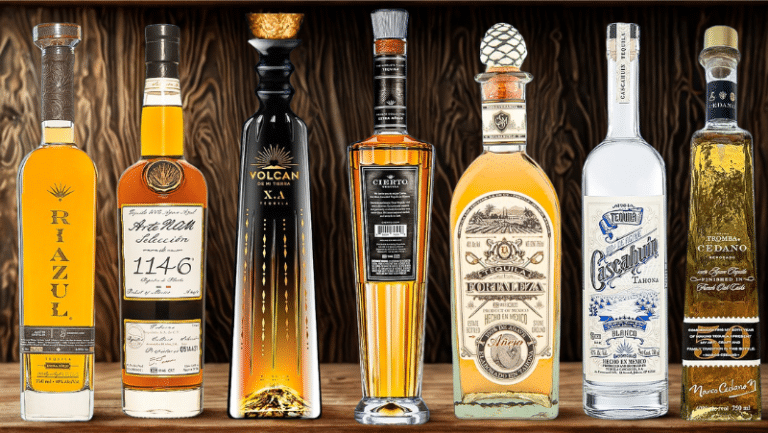

How to Read Tequila Labels: A Complete Guide
The founders of Tequila Matchmaker, who ran the additive-free inspection programme, estimate that at least 70% of tequila…
The founders of Tequila Matchmaker, who ran the additive-free inspection programme, estimate that at least 70% of tequila on the market contains additives — and that up to 80% of the bottles they tested failed their own additive-free standard. Neither figure has published methodology behind it, so treat them as informed estimates rather than measurements. The point stands either way: nothing on the label would tell you. Understanding how to read tequila labels is the key to finding authentic, high-quality spirits! As tequila continues to surge in popularity, knowing what’s in your bottle has never been more important. From decoding NOM numbers to understanding aging classifications, this guide will transform you from a casual sipper to a tequila connoisseur. I’ve spent years studying tequila production and can tell you that what’s written on the label (and sometimes what’s conveniently left off) tells the real story of what’s in your glass.
What Mexican Law Requires on Every Tequila Label
This is the official list from NOM-006-SCFI-2012, §11.1, the standard every bottle of tequila has to meet. Items marked Front must appear on the principal display surface (§11.2.1); the rest can appear anywhere on the label or packaging.
| Required item | What it looks like | Where |
|---|---|---|
| The word “Tequila” | Tequila | Front |
| Category and class | “100% de agave” or “Tequila” (mixto), plus blanco, joven, reposado, añejo or extra añejo | Front |
| Added flavour, aroma or colour | Named on flavoured tequilas | Front |
| Net contents | “Cont. Net. 750 ml” or “70 cl” | Front |
| Alcohol content | “38% Alc. Vol.”, measured at 20 °C | Front |
| Brand | The brand name or logo | Front |
| Producer’s name and address | “Producido y envasado por…” with the licensed producer’s legal name | Anywhere |
| Origin | “Hecho en México,” “Producto de México” or “Elaborado en México” | Anywhere |
| Official mark and producer number | The NOM logo with the four-digit producer number, e.g. NOM 1459. The certifier’s “CRT” mark usually sits beside it. | Anywhere |
| Lot | “Lote: …” or a code printed or etched on the bottle | Anywhere |
| Health warnings | “El abuso en el consumo de este producto es nocivo para la salud,” with pictograms | Anywhere |
Notice what isn’t on the list: additives. Mexican regulation permits up to 1% of finished volume in caramel colouring, oak extract, glycerin and sugar-based syrup, and nothing requires a label to declare any of it. A label can tell you a great deal, but it can’t tell you whether a tequila is additive-free.

Understanding Tequila Classifications and Types
Blanco (or Silver) tequila is unaged or aged less than two months. It’s got that bright, peppery kick that makes you know you’re drinking tequila – perfect for margaritas.
Reposado means “rested” in Spanish. These are aged in oak barrels for 2-12 months. The wood mellows out the sharpness and adds hints of vanilla and caramel. My personal sweet spot for sipping!
Añejo tequilas are aged 1-3 years and develop incredible complexity. They’re smoother, darker, and pick up more wood characteristics – think butterscotch, chocolate, and spices.
Extra Añejo is aged over three years and can get pretty pricey. My brother-in-law bought me a bottle for my birthday, and it was like drinking liquid gold – smooth, rich, with almost no burn.
Cristalino tequilas are aged tequilas that undergo charcoal filtering to remove the color while keeping the smooth aged flavors. You get the complexity of an aged tequila with the crystal-clear appearance of a blanco.
Joven or Gold tequila usually means mixtos with caramel coloring added to fake the aged look. For years, I thought gold meant better quality. Wrong!
All these classifications directly impact flavor profile and quality. The longer the aging, generally the smoother and more complex the flavor, and yes, the higher the price tag.
Decoding the NOM Number: The Key to Tequila Authenticity
I never knew what those numbers on tequila bottles were, until a bartender friend schooled me on NOM numbers. What I learned was really interesting.
NOM
So what exactly is a NOM? It stands for Norma Oficial Mexicana, which is basically the Mexican government’s regulatory seal of approval. Every legit bottle of tequila has a four-digit NOM number somewhere on the label – usually in tiny print on the back or bottom. This little number is like a secret code that tells you which distillery actually made your tequila.

It is interesting to find out that several of my “different” premium tequilas all shared the same NOM! That’s because many distilleries produce multiple brands under the same roof. Some mega-distilleries pump out dozens of different brands, everything from cheap mixtos to the most well-known brands.
Generally speaking, distilleries with fewer brands under their NOM tend to be more artisanal and hands-on with their production. The ones with 20+ brands? Usually mass-production operations. Neither is automatically better, but they’re definitely different approaches to making tequila.
CRT – Consejo Regulador de Tequila
Another tip I’ve learned is to look for the CRT seal alongside the NOM. The Consejo Regulador del Tequila is the regulatory council that ensures the tequila meets all the official standards. If it doesn’t have both a NOM and CRT certification, it ain’t real tequila, folks.

Remember, the NOM doesn’t tell you if the tequila is good or bad; it just tells you where it was born. But knowing this little secret helps you become a more informed buyer and sometimes saves you from paying premium prices for essentially the same product in different packaging.
Understanding Aging Statements, Barrel Information & Additives
Don’t get fooled by fancy labels. There is no legal definition beyond the standard classifications.
Tequila Aging
Blanco tequila doesn’t require aging at all or might rest up to 2 months in stainless steel. Reposado must be aged at least 2 months but less than a year. Añejo needs to hang out in barrels for 1-3 years. Extra Añejo must be aged for a minimum of 3 years. Anything less, and they legally can’t use these classifications.
Single Barrel vs Blended
Single barrel vs blended tequila is another characteristic to note. Single barrel means exactly what it sounds like – tequila from just one barrel, bottled unblended. These tend to have more distinct character but less consistency between batches. Most tequilas are blended from multiple barrels to create a consistent flavor profile. The label will usually say “single barrel” if that’s what you’re getting, otherwise assume it’s blended.
The batch and bottle numbering systems still confuse me sometimes. Small-batch tequilas often include batch numbers (like “Batch 17”) that help identify when they were produced. Some premium bottles include specific bottle numbers (like “Bottle 342 of 500”) to indicate limited production.
I personally think tequilas that come from small batches are the best tasting, but I am not sure if this is just a preconceived notion.
Additives in Tequila
Authentic tequila is made from the fermented and distilled juice of the blue agave plant, but not all tequilas are created equally. There are two primary categories: 100% agave tequila and mixto tequila.
- 100% Agave Tequila: This type is pure, with no additives required, though some brands may legally add small amounts (under 1%) of substances like caramel coloring, oak extract, glycerin, or sugar-based syrup to adjust flavor or appearance.
- Mixto Tequila: Contains at least 51% agave sugars, with the remaining portion coming from other sugars such as cane or corn syrup. Mixto tequilas often have more additives, including artificial coloring and sweeteners.
Understanding Tequila Labels: DOT, Hecho en México, and Alcohol Content
When purchasing a bottle of tequila, the label provides crucial information about its authenticity, origin, and strength. Three key indicators to look for are the Denominación de Origen (DOT), “Hecho en México”, and alcohol content.
Denominación de Origen (DOT)
The Denominación de Origen Tequila (DOT) is a legal certification that ensures tequila can only be produced in specific regions of Mexico—primarily the state of Jalisco and select municipalities in Guanajuato, Michoacán, Nayarit, and Tamaulipas. This designation protects the integrity and authenticity of tequila, similar to how Champagne must come from the Champagne region of France. If a bottle does not have the DOT, it is not legally recognized as tequila.
Hecho en México (Made in Mexico)
The phrase “Hecho en México” (Made in Mexico) is another key label indicator. True tequila must be distilled and bottled in Mexico to meet regulatory standards. Some brands may export bulk tequila for bottling elsewhere, but to ensure quality and authenticity, it’s best to choose tequilas that are bottled at origin and clearly state “Hecho en México” on the label.
Alcohol Content in Tequila
Tequila must have a minimum alcohol content of 35% ABV (alcohol by volume), but the most common level is 40% ABV, particularly for exports to the U.S. and other international markets. Some bottles may have a slightly higher ABV, particularly in specialty or artisanal brands.
What to Look for In A Tequila Bottle Label
- Types of Tequila – Blanco (Silver) – Unaged, pure agave flavor. Reposado – Aged 2-12 months in oak barrels. Añejo – Aged 1-3 years, richer and smoother. Extra Añejo – Aged over 3 years, deep complexity.
- NOM (Norma Oficial Mexicana) – You can look up the NOM number to verity where and by whom the tequila was produced.
- CRT (Consejo Regulador del Tequila) – This label ensures the tequila meets official standards.
- Purity – For the best quality, choose 100% agave tequila, as it provides a pure, unaltered taste. Check for labels that explicitly state “100% Agave” to avoid mixto tequilas. If you prefer a tequila without additives, look for brands that adhere to minimal processing and transparency. Tequilas labeled Blanco or Plata are often the purest, while some aged varieties (Reposado, Añejo) may have subtle additives.
- Ensure it has the DOT to confirm authenticity.
- Look for “Hecho en México” to guarantee proper production and bottling.
- Check the alcohol content (40% ABV is standard for premium tequila).
Reading Real Labels: What My Own Bottles Show
Everything above is what a tequila label is supposed to tell you. Here is what real labels actually say, read off bottles on my own table and photographed on 20 September 2026. Each one teaches something a checklist can’t.
The brand on the front is not who made it
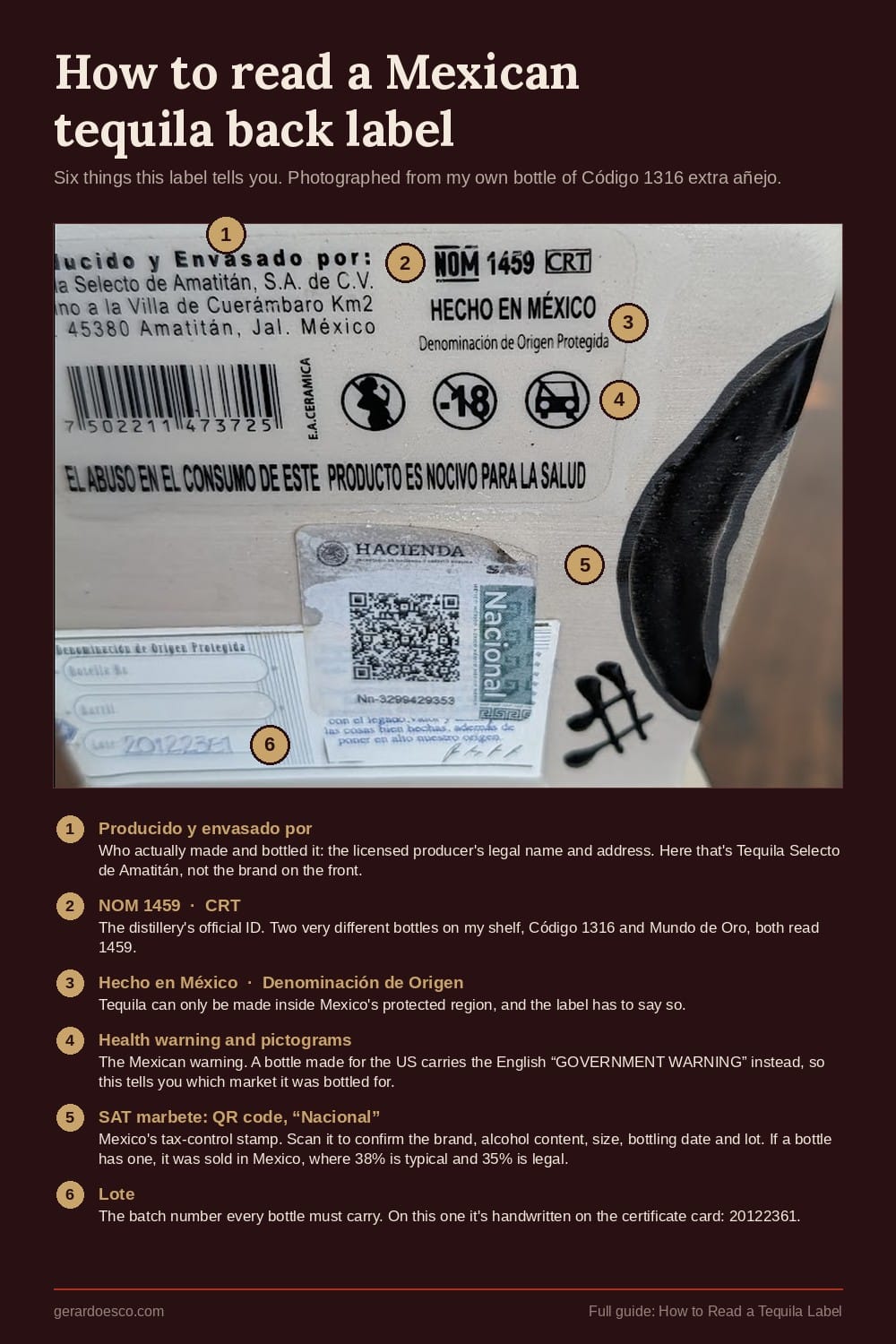
My Código 1316 extra añejo comes in a hand-painted ceramic decanter covered in musical notes. My Mundo de Oro añejo cristalino comes in a smoked-glass decanter. They look nothing alike, and both back labels read NOM 1459, produced and bottled by Tequila Selecto de Amatitán in Amatitán, Jalisco. One distillery, two brands. The front of the bottle does brand work; the NOM does identification work. Here’s what the NOM number means, and the NOM directory shows which brands share a distillery.
“Para” means somebody else made it
The embossed label on my La Cuerda añejo says “Producido y envasado por: El Patriota Agave Spirits, S. de R.L. de C.V., El Salto, Jalisco, México. Para: Comercializadora Felix Huato, S.A. de C.V.” That little word para, “for,” tells you the company that owns the brand is not the company that made the tequila. It’s normal and it’s legal, and it’s the fastest way to spot a contract-made bottle. Watch for para, elaborado para, or hecho para.
The same brand can carry different NOMs
I have two Don Ramón bottles. The Platinium añejo cristalino reads NOM 1417, made by Industrializadora Integral del Agave in Tlaquepaque. The Reserva de Don Ramón reposado reads NOM 1590. Same brand name, two different NOMs. Brands move production between distilleries, so the NOM on one bottle tells you nothing certain about the next. Read the bottle in your hand, not the brand’s reputation.
The age statement is the most useful sentence on a reposado
The back of my Gran Centenario Azul reposado says it rests “2 meses en barricas de roble blanco”: two months in white oak. Two months is the legal minimum for a reposado. Most labels only give you the category. When a label states the actual time in wood, it’s telling you exactly where in the category that bottle sits. That same label also gives the plant, Ex Hacienda Los Camichines in La Laja, Zapotlanejo, under NOM 1122, the same NOM as Jose Cuervo.
The alcohol content is on the front, by law
Mexico’s tequila standard, NOM-006-SCFI-2012, requires six things on the principal display surface, the front: the word “Tequila,” the category and class, any added flavour or colour, the net contents, the alcohol content, and the brand. Everything else, including the NOM and the producer’s address, can go on the back. That’s why the 35% Alc. Vol. on my Código 1316 and Mundo de Oro sits on the front label while the NOM is on the back. Why some tequila is only 35%.
A lot code is required, and it’s often on the glass
Every bottle must carry a lot (batch) identification. On my Don Ramón Platinium it’s printed straight onto the glass: L3DRAC060524A. On my Código 1316 it’s handwritten on a small certificate card: Lote 20122361. If you ever need to report a bad bottle or compare two purchases, this is the number that matters.
How to Tell a Mexican-Market Bottle From a US One
The same brand and expression can be bottled differently for each country, so it’s worth knowing which one you’re holding. Five clues give it away:
| Clue | Bottled for Mexico | Bottled for the US |
|---|---|---|
| Health warning | “El abuso en el consumo de este producto es nocivo para la salud,” plus pictograms | “GOVERNMENT WARNING,” in English |
| Tax stamp | SAT marbete: a sticker with a QR code, often marked “Nacional” | None |
| Alcohol content | Anywhere from 35% to 55%. 38% is common, and 35% turns up on premium decanters. | 40% minimum, by US law |
| Bottle size | 700 ml (“70 cl”) is common, alongside 750 ml and 1 L | Overwhelmingly 750 ml |
| Importer line | None | “Imported by…” naming a US company |
Why it matters: my Mexican-market Don Julio Blanco reads 38%, and the same expression sold in the US is 40%. Neither label is wrong; they’re two different bottlings. If a bottle carries a SAT marbete, you can scan the QR code with the SAT’s verifier to confirm the brand, alcohol content, size, bottling date and lot, which is also a quick authenticity check.
Conclusion
Learning how to read tequila labels is your passport to discovering authentic, high-quality spirits that match your taste preferences! By understanding NOM numbers, aging classifications, production methods, and certification symbols, you’re now equipped to see through marketing gimmicks and find tequilas that represent true craftsmanship. Next time you’re browsing the spirits aisle, put your new knowledge to work—your palate will thank you! Remember, the best tequila isn’t always the most expensive or the most heavily marketed—it’s the one produced with integrity, which you can now identify right from the label.
Tequila Label FAQ
Where is the NOM number on a tequila label?
Usually on the back label, next to the letters CRT, for example “NOM 1459 CRT.” Some brands print it on the front instead: my el Jimador reposado has NOM 1119 on its front label and none on the back.
Can two tequila brands have the same NOM?
Yes, and it’s common. My Código 1316 and Mundo de Oro both read NOM 1459. Contract distilleries make tequila for many brands. Destilería Leyros, NOM 1489, produces around 38.
What does “para” mean on a tequila label?
It means “for.” A line such as “Producido y envasado por [distillery] para [company]” tells you the brand owner and the producer are different companies.
What is the QR code sticker on Mexican tequila bottles?
It’s the SAT marbete, Mexico’s tax-control stamp for alcoholic beverages. Scanning it lets you confirm the brand, type, alcohol content, container size, origin, bottling date and lot. A bottle with a marbete was sold in Mexico.
Why does my tequila say 70 cl?
70 cl is 700 ml, a common bottle size in Mexico and Europe. It holds 50 ml less than the 750 ml standard in the US, so check the size as well as the price.
Does the label tell you if a tequila has additives?
No. Mexican regulation allows up to 1% of finished volume in approved additives without any disclosure on the label. See additive-free tequila for what you can still check.
Learn More About Tequila
- How to Taste Tequila Like An Expert
- What is Añejo Tequila?
- What is the Tequila Flavor Wheel? Complete Guide
- How to Choose the Best Tequila: Complete Guide
- Tequila Vs. Mezcal: Key Differences
- What Does NOM Mean on Tequila?
- Types of Tequila: Blanco, Reposado and Añejo