
Blanco is the tequila with nowhere to hide. No barrel, no colour, no time — whatever the distillery did to the agave is what arrives in your glass. That makes it the best category for learning what tequila actually tastes like, and the worst one for covering up a bad batch.
Some links on this page are affiliate links. If you buy through one, this site earns a commission at no extra cost to you. It does not change which bottles are recommended or what is said about them. Full disclosure.
What Is Blanco Tequila?
Blanco is tequila bottled without meaningful time in wood. Under Mexico’s NOM-006-SCFI standard it goes straight from the still to the bottle, or rests up to two months in stainless steel or neutral tanks first. It is clear because nothing has coloured it.
Every other category starts here. Reposado is blanco that spent two to twelve months in oak. Añejo is blanco that spent one to three years. Extra añejo is blanco that spent more than three. The liquid in a $400 extra añejo began its life as the same distillate sold as blanco — which is worth remembering the next time a price list implies otherwise.
Blanco, silver, plata, platinum: is there a difference?
No. Blanco is the Spanish term and the one used in the regulation. Plata is a synonym. Silver and platinum are English-language marketing words for the same unaged spirit. A bottle labelled “silver” is not a different category from one labelled “blanco.”
There is one thing worth watching. Because “silver” is a marketing word rather than a regulated one, it turns up disproportionately on inexpensive mixto bottles — and that is a real difference, just not the one the word suggests. Our silver vs gold guide works through what that means at the shelf.
What Blanco Tequila Tastes Like
Cooked agave first — sweet, vegetal, something close to roasted sweet potato or steamed artichoke. Then citrus, white pepper, green herbs, and often a clean mineral or saline edge on the finish. Good blanco is peppery without being harsh and sweet without being sugary.
Where it was made changes the profile more than in any other category, because there is no oak sitting on top of it:
- Los Altos (the Highlands) — higher, cooler, iron-rich red soil. Tends towards riper, sweeter, more floral and fruit-forward agave.
- Valles (the Lowlands) — the valley floor around the town of Tequila. Tends earthier, more peppery, more herbal and mineral.
These are tendencies, not laws, and plenty of bottles sit between them — but with a blanco in each hand the difference is usually obvious. Our guide to the five tequila regions maps the rest.
How the agave was cooked and milled matters just as much. Brick ovens and stone tahona milling generally produce a rounder, more layered blanco than autoclaves and roller mills; diffuser-extracted tequila tends to taste thinner and more industrial. None of this is printed on the label, which is why the NOM number is worth learning to read.
The Two Words That Matter More Than “Blanco”
Before anything else on the label, find 100% agave.
If those words are absent, the bottle is a mixto: Mexican law only requires 51% of the fermentable sugars to come from agave, and the remaining 49% can be cane or corn sugar. Mixto blanco is a different drink from 100% agave blanco, and it is most of what sits on the bottom shelf.
Second, find the NOM — a four-digit number identifying the distillery that actually made the liquid. One NOM can produce dozens of brands, and it does not indicate quality on its own, but it tells you who is really behind the bottle. NOM 1487, for example, is Bacardí’s distillery in Arandas: it makes Cazadores, which is 100% agave, and Camino Real, which is a mixto. Same building, same number, two very different bottles.
Third — and this one is invisible — Mexican regulation permits up to 1% of finished volume in four additives: caramel colouring, oak extract, glycerin and sugar-based syrup. None has to be disclosed. In blanco, where there is no oak to hide behind, glycerin and syrup are the ones that matter, because they change mouthfeel and perceived sweetness directly.
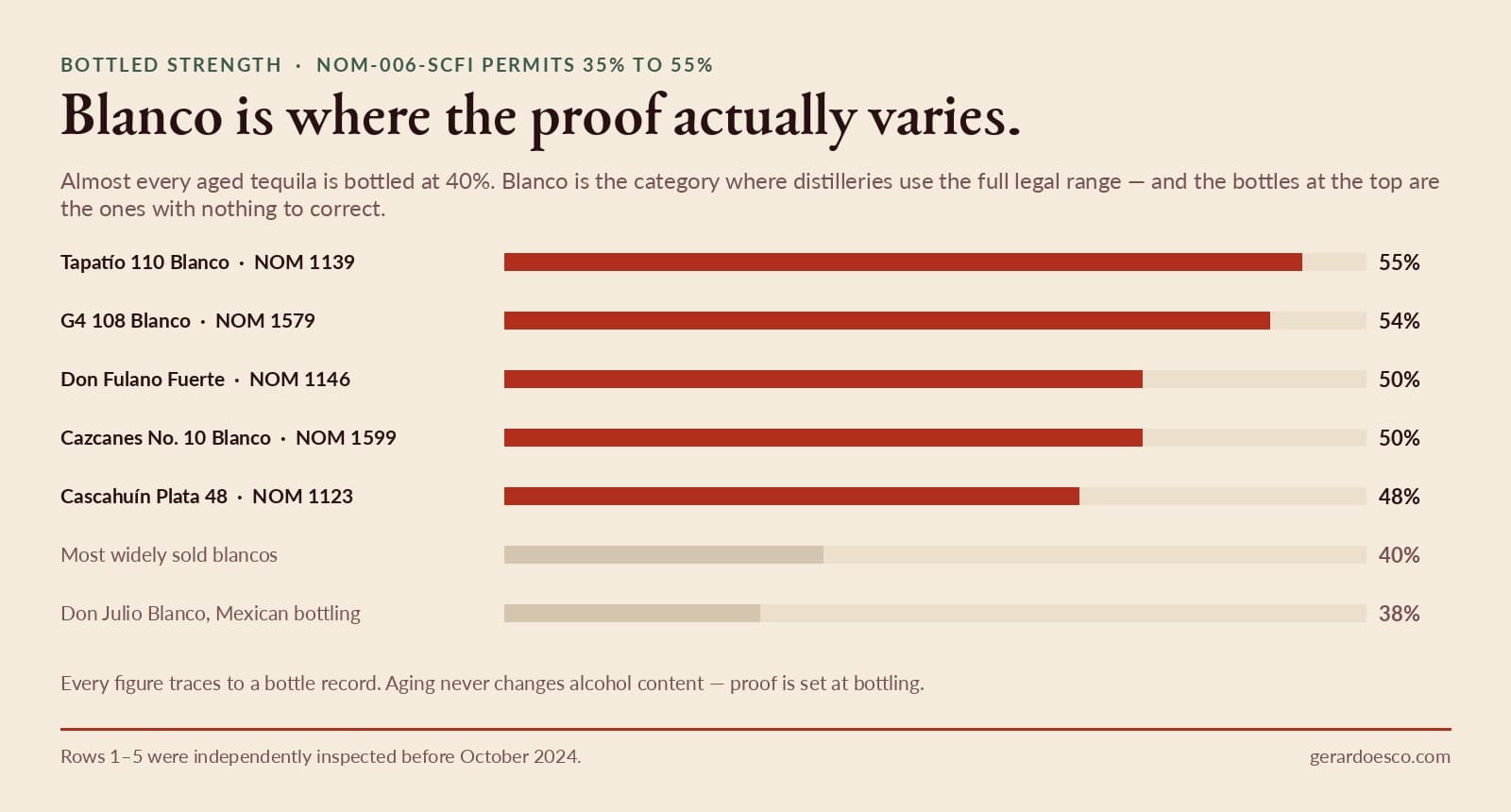
Blanco Is the Category Where Proof Actually Varies
Almost every aged tequila you will see is bottled at 40% ABV. Blanco is the exception, and it is not a small one: NOM-006-SCFI allows anything from 35% to 55%, and blanco is where distilleries actually use that range.
This matters because proof is set at bottling, not in the barrel. A higher-proof blanco is not stronger by accident — it is a deliberate choice to bottle closer to still strength, and it usually means more agave character, more texture and more heat. Every figure below is from a bottle recorded in our own reference sheet.
| Bottle | ABV | NOM | Additive-free verified? |
|---|---|---|---|
| Tapatío 110 Blanco | 55% | 1139 | ✓ Verified |
| G4 108 Blanco | 54% | 1579 | ✓ Verified |
| Don Fulano Fuerte | 50% | 1146 | ✓ Verified |
| Cazcanes No. 10 Blanco | 50% | 1599 | ✓ Verified |
| Cascahuín Plata 48 | 48% | 1123 | ✓ Verified |
| Most widely sold blancos | 40% | various | varies |
| Don Julio Blanco (Mexican bottling) | 38% | 1449 | Not on the list |
Two things stand out. First, that 55% Tapatío and that 38% Don Julio are both legally tequila, sold under the same standard, seventeen percentage points apart. Second, every bottle at the top of that table is independently verified additive-free — which is not a coincidence. Distilleries confident enough to bottle at still strength tend to be the ones with nothing to correct afterwards.
The 38% figure is not a typo either: Mexican-market bottlings of several major brands come in below the 40% the US requires. Our tequila proof and alcohol content guide has the full picture.
Blanco Tequila Worth Buying
Two lists, because they are not the same list.
Widely available, easy to find
These are the blancos you can walk into most stores and buy today.
| Bottle | ABV | NOM | What you’re getting |
|---|---|---|---|
| Olmeca Altos Plata | 40% | 1111 | The value benchmark. 100% agave at a price where most competitors are mixto. The blanco to build a home bar around. |
| Herradura Blanco | 40% | 1119 | Rested slightly longer than most blancos, which softens it. Rounder and less sharp — a good margarita base that also holds up neat. |
| Patrón Silver | 40% | 1492 | The one everybody recognises. Clean, soft, citrus-forward, and consistent bottle to bottle. You are paying something for the name. |
| Patrón El Cielo | 40% | 1492 | Quadruple-distilled and noticeably lighter and more floral than the standard Silver. A sipping blanco rather than a mixing one. |
Independently verified additive-free
These are harder to find and usually worth the hunt. None of them carries a tracked link on this site — which is exactly why the two lists are printed separately rather than blended into one ranking.
- Fortaleza Blanco (NOM 1493) — stone tahona milling, open-air fermentation, copper pot stills. The reference point for what blanco can be.
- Tapatío Blanco and Tapatío 110 (NOM 1139)
- G4 Blanco and G4 108 (NOM 1579)
- Cascahuín Blanco and Plata 48 (NOM 1123)
- Don Fulano Fuerte (NOM 1146)
- Cazcanes No. 10 Blanco (NOM 1599)
“Verified” here means something specific, and something that has changed. These distilleries were physically inspected by the Additive Free Alliance, whose findings were published through Tequila Matchmaker. That list was taken down in October 2024, after Mexico’s tequila regulator warned brands that additive-free claims could get their product seized. The inspections were real and the results stand, but there is no longer a public register a consumer can check.
Which also means “not verified” is not an accusation, and never was. Plenty of excellent distilleries were simply never inspected before the programme stopped. Treat a past inspection as a positive signal; treat its absence as no signal at all.
How to Drink Blanco Tequila
Neat, at room temperature, in a glass that narrows at the top. Not a shot glass, and not chilled — cold flattens the agave and hides exactly the character you paid for. A copita or a small wine glass works. Sip it; blanco is not a drink you need to hurry past.
In a margarita. Blanco is the correct choice, not the cheap one. Its citrus and pepper are what the lime and orange liqueur are built around; a reposado in the same glass mostly tastes of oak. Use a 100% agave blanco even in a mixed drink — mixto is where margarita hangovers come from.
With sangrita, not salt and lime. Salt and lime exist to cover the taste of something you would rather not taste. A good blanco does not need covering. Sangrita — a chilled citrus-and-chile chaser — is the traditional partner and a far better one.
Our guides to tasting tequila and the tequila flavour wheel go further if you want to get systematic about it.
Blanco Tequila: FAQ
Is blanco tequila the same as silver tequila?
Yes. Blanco, plata, silver and platinum all describe unaged tequila. The difference is language and marketing, not category.
Is blanco tequila stronger than reposado or añejo?
Sometimes, but not because it is unaged. Aging does not change alcohol content — proof is set at bottling. Blanco is simply the category where distilleries most often bottle above 40%, with several well-known bottles at 48–55%.
Is blanco tequila good for sipping?
Very. A 100% agave blanco served neat at room temperature is the clearest expression of what the distillery actually makes. If you have only ever had blanco as a shot, you have not really had it.
Why does blanco tequila burn more?
Usually one of two reasons: it is a mixto, or it is bottled at higher proof. A well-made 100% agave blanco at 40% should be peppery and warm, not harsh. Harshness at that strength is a sign of how it was made, not of the category.
Does blanco tequila go bad?
Unopened and stored upright away from light and heat, it keeps effectively indefinitely. Once opened it slowly oxidises and flattens over a year or two. Our guide to tequila storage covers the details.
What is the best blanco tequila for margaritas?
Any 100% agave blanco with a clean citrus-pepper profile. Olmeca Altos Plata is the usual value answer; Herradura Blanco is the softer one. Avoid mixto, which is the actual cause of most bad margarita experiences.
Where to Go Next
- The five types of tequila — how blanco fits against reposado, añejo, extra añejo and joven
- What the NOM number means — how to find out who really made your bottle
- Silver vs gold tequila — why gold is usually colour, not age
- Tequila proof and alcohol content — the full 35–55% range explained
- How to read a tequila label